OPTIMJACK: malicious code via Optimizely on CNN, BBC and Salesforce
On 16 November, malicious code ran on almost 200 major websites through the A/B testing tool Optimizely. What happened, what you should do now and why I serve as much as possible from a website's own server.
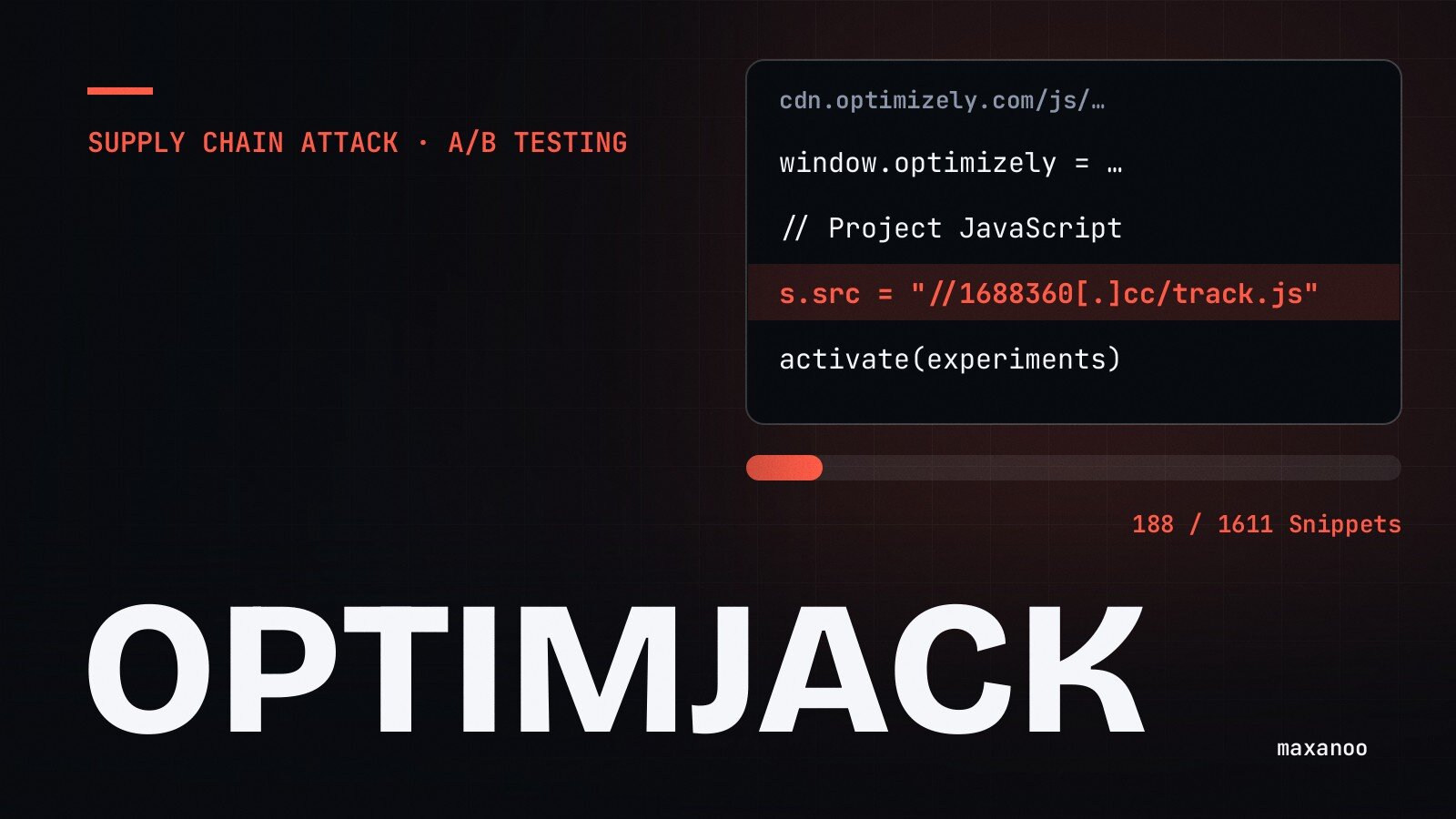
On 16 November 2026, visitors to CNN, the BBC, Salesforce, Zoom, IKEA, HSBC and many other websites ran malicious code without noticing. The code did not come from those companies' servers. It came through Optimizely, a service for A/B testing. Security researcher Scott Helme of Report URI tracked the attack and named it OPTIMJACK.
The case shows very clearly why I put so much weight on serving everything from the website's own server. More on that below. First: what happened?
What happened?
Optimizely is added to a website with a small JavaScript snippet. Every customer has their own snippet, delivered through Optimizely's CDN. It contains a field for the customer's own code, called "Project JavaScript".
In many unrelated customer projects, the attackers added a line to exactly this field that loads more code from a foreign domain. In some cases the address was obfuscated, in others the complete payload sat directly in the snippet. The CDN itself was not tampered with. It simply delivered what was stored in the projects, from the usual server and with a valid certificate.
Optimizely has since confirmed the entry point: according to its status page, an unauthorised party exploited a vulnerability in Optimizely Experimentation; a spokesperson told Gizmodo the flaw was in the account signup flow. Optimizely says it has blocked this path and deployed a fix.
Helme saw the first change at around 4:20 UTC in the BBC's snippet. In a check that evening, 188 of 1,611 examined snippets were infected, belonging to 178 organisations. The real number is probably higher. According to Report URI, all infected files were clean from 23:11 UTC.
Separately, the security company Hudson Rock recovered and analysed eight tampered Optimizely project files. They belong to sites including the BBC, Zoom, GitLab, HSBC (UAE), Hootsuite, Virgin Media O2 and Stamps.com. Archived captures by another researcher show the malicious code on Salesforce, CNN, Fox News and FAZ as well. Hudson Rock also found similar code in scripts from Kissmetrics, StorifyMe and minute-ly, so this was not only about Optimizely.
What the malicious code did
- Swapping crypto addresses: wallet addresses that visitors copied or typed were replaced with addresses controlled by the attackers.
- Reading card data: card number, expiry date and security code were taken from the website's own forms. Embedded payment fields from providers such as Stripe or Adyen were not affected.
- Cookies and screenshots: on pages with payment or wallet content, cookies and a screenshot of the page were sent to the attackers.
- Attacks on iPhones: on older iOS versions, a hidden frame with exploit code was loaded as well.
Why the usual protection barely helped
The standard defence against injected JavaScript is a Content Security Policy (CSP). It lets a website define where scripts may be loaded from and where data may be sent. Helme crawled 256 hosts of the affected organisations and evaluated the result per organisation. The CSP blocked the payload for only 24 of them, about 15 percent. 68 had no CSP at all, 50 let the code run unhindered, and for 17 the code ran but could not send any data.
The problem: anyone using Optimizely has to allow the Optimizely server in their CSP. The malicious code came from exactly that server. Optimizely's documentation also recommends settings such as 'unsafe-eval', which made the attack even easier. What worked best was a strict rule on where the browser may send data (connect-src).
Indicators of compromise
Report URI published these indicators. The domains are defanged here, with [.] instead of a dot.
- Loaded script:
1688360[.]cc/track.js. In some projects the address was hidden as Base64 and decoded withatob(). A plain-text search for the domain does not find this variant. - Full copy in the snippet: In some projects, for example the BBC and HSBC (UAE), the entire payload sat directly in the Project JavaScript and ran via
eval. Blocking the domain does not help here. - Exfiltration:
1688360[.]cc/card.php(card data),1688360[.]cc/hit.php(cookies, page URL, screenshot), plus1688360[.]cc/html2canvas.min.js. - iPhone attacks:
5vobauua3ojpklx[.]icuandeil786npto9u5bq[.]icu(bothboot.js), telemetry vial7bcsnwc7nzr3uo[.]icu. - Further infrastructure:
webshell[.]lol,linkforge[.]cc,je4ft3gn8vxudum[.]icu,q1ls1ho9x7wsxlu[.]icu,ios-hack[.]icu.
According to StepSecurity, the domain 1688360[.]cc was only registered on 16 November, the day of the attack. If you find requests to any of these domains in DNS, proxy or CSP report logs, assume a compromise. The full list is in Report URI's analysis.
What you should do now
If your website uses Optimizely Web:
- Check the Project JavaScript and the custom code of all experiments: search for
1688360,atob(andeval, and for anything you did not write yourself. - Search DNS, proxy and CSP report logs for the domains listed above.
- Review who has write access, and renew logins and API tokens.
- Treat card data entered into your own forms on 16 November as compromised. This may trigger a notification duty under the GDPR. The same applies to session cookies without the HttpOnly flag.
- Use a CSP with a tight
connect-srcand enable violation reports.
As a visitor: update your iPhone and iPad, compare crypto addresses carefully before sending, and keep an eye on your card statement if you paid by card on an affected site on 16 November.
Why I serve as much as possible myself
Every script a website loads from a foreign server runs in the browser with the same rights as the site's own code. It can read forms, change content and send data. Embedding such a script means trusting the security of another company, its staff and its logins. With OPTIMJACK, that trust hit almost 200 websites at once, on a single day.
That is why my projects follow a few simple principles:
- Fonts, images, stylesheets and scripts live on the website's own server. No libraries from public CDNs, no fonts from Google Fonts.
- As little JavaScript as possible in the frontend. Pages work without it. What isn't there can't be swapped out.
- Features belong on the server. Forms, statistics or an A/B test can be built server-side. The variant is then already in the HTML, with no third-party script and no flicker while loading.
- Statistics on our own infrastructure instead of with an advertising company.
- Payment by redirect. To pay, visitors are sent to the payment provider's own page. Card data is never entered on the website itself, so a skimmer like OPTIMJACK would find nothing there.
- Third-party services only for a good reason. Where there is no way around it, the decision is conscious, documented and secured with a CSP.
This is not only about security. Every foreign server learns your visitors' IP addresses. In 2022, a German court (Landgericht München) ordered a website operator to pay damages because the site loaded Google Fonts from Google's servers. And every additional server costs loading time.
To be honest: serving everything yourself does not protect against everything. The server has to be maintained, updates installed, access managed properly. But then the responsibility sits in one place that you know and control, not spread across a dozen services, each of which can become the weak spot.
How many third-party scripts does your website load?
Most site owners don't know exactly. Over the years, tag managers, chat widgets, testing tools and tracking pixels pile up, and things are rarely removed.
The free shop check gives you a first overview: it lists which resources your home page loads from third-party servers and shows whether a Content Security Policy is set. It works for any website, not only for online stores.
For a thorough review, I will look at your website, list every external source, tell you which ones are needed and which can be served locally, and set up a suitable CSP if you like. Just write to me with the website in question.
Sources: Scott Helme / Report URI: "World's Largest Brands Infected With Malware Via Optimizely" (primary source with the full list of indicators), Hudson Rock / Infostealers.com and StepSecurity. Summaries among others at daily.dev and LAVX News. As of 17 November 2026.